

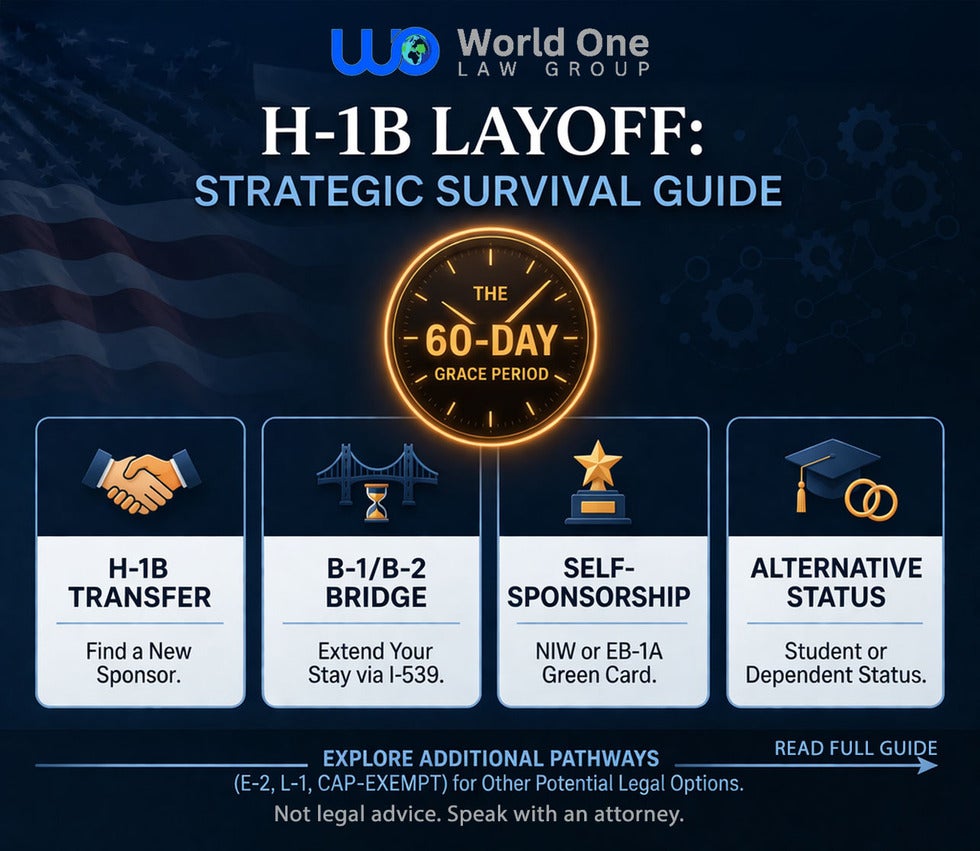
Navigate 2026 tech layoffs with this strategic guide to the H-1B 60-day grace period, covering H-1B transfers, B-2 bridge visa options, and legal pathways to maintain your lawful status.
If you were recently laid off from your employer while on an H-1B visa, you may be wondering about how to stay legally in the United States. You are not alone, and you do have options.
As a U.S. Immigration attorney, I developed this guide to help you and the thousands of others in your unfortunate situation to understand your options and make informed decisions.
It is critical to develop an immigration strategy that ensures you stay in lawful status, as timing is critically important.
This guide explains some of the major paths available to you, how they work, and how to think about them strategically.
- 60-Day Grace Period
- Option 1: H-1B Transfer
- Option 2: B-1/B-2 Bridge
- Option 3: Startup
- Option 4: O-1 Visa
- Option 5: EB-2 NIW
- Option 6: EB-1A
- Option 7: Cap-Exempt
- Option 8: Marriage
- Option 9: L-1 Visa
- Option 10: E-1/E-2 Visa
- Option 11: AC21
- Option 12: Concurrent H-1B
- Emergency Action Plan
- What Not To Do
- Strategic Perspective
As of March 2026, the technology sector continues to undergo a massive structural realignment driven by AI infrastructure costs and operational restructuring.
| Company | 2026 Layoffs | Strategic Driver |
|---|---|---|
|
Oracle |
~30,000 |
AI infrastructure costs |
|
Amazon |
16,000 |
Corporate restructuring |
|
Meta |
~15,800 |
AI productivity pivot |
|
Block |
4,000 |
AI-first operating model |
Note: Over 45,000 tech jobs have been cut globally in Q1 2026.
Understand Your 60-Day Grace Period
When your H-1B employment ends, you generally receive up to 60 days grace period to remain in the United States, or until the date that your I-94 expires (whichever is soonest). For official details, refer to the USCIS H-1B Specialty Occupations page. During this time, you may:
- Search for new employment
- Transfer to a new employer in H-1B status
- Change status to a different visa category
- File certain immigration petitions that give legal protections
You are not required to leave immediately if your H-1B position is terminated. But the 60-day clock starts the day your employment ends. You should explore your long-term legal strategy to find the best way to remain in the United States.
Get Fast Legal Assistance
When time is limited and strategy is critical, speaking with an immigration attorney as soon as possible is essential. An attorney can provide a customized and tailored assessment of your specific situation and help you pursue the strongest options available to you.
Important Disclaimer: This guide article is purely informational and does not constitute legal advice, as it is not customized to your individual circumstances and immigration history.
World One Law Group understands the urgency of your situation and specializes in helping H-1B visa holders transition to appropriate immigration solutions during employment transitions. As Managing Attorney, I recommend you contact us for an initial consultation to discuss your specific options and develop a personalized strategy tailored to your needs.
OPTION 1: Transfer to a New H-1B Employer
Finding a new H-1B employer is a popular option for remaining in the United States after leaving your job. You are legally allowed to apply for positions, attend interviews, and accept new job offers during your grace period. If a new employer files an H-1B petition before your grace period expires:
- You may remain in the United States legally
- You may begin work for the new employer as soon as your H-1B petition is filed
- Your H-1B status continues
Important: The petition must be properly filed before Day 60. Even after you accept a job offer, it can take weeks to prepare and file a Labor Condition Application and H-1B petition for your new position. Be prepared to take action to stay in lawful status until the new petition is filed.
OPTION 2: File a Change of Status to B-1/B-2 Visitor Visa (Bridge Strategy)
If you need more time to search for employment or to have your new employer file an H-1B petition for you, consider filing to change your status to a visitor visa (also called a B-1/B-2 visa) to give you extra time in the United States beyond your 60-day grace period. This change of status request must be filed within your grace period to keep you in legal immigration status. Review the official Form I-539 instructions for filing details.
A properly filed I-539 Change of Status application can:
- Extend your lawful presence for up to 6 months per request
- Give you additional time to secure employment or depart the United States
- Preserve your immigration record
The B-1/B-2 visa does not allow you to work legally. Working without authorization during this time could cause problems for you in the future. Your change of status request acts like a bridge from one H-1B employer to another. Once that H-1B petition is filed, you can withdraw your request to change status to a visitor visa online, or by written request to the USCIS.
OPTION 3: Start Your Own Company and Sponsor Yourself
If you have an idea for your own company, it may be possible for that new company to sponsor you for an H-1B visa. This option must be structured correctly to meet the requirements of the H-1B visa, as this visa status doesn't allow for a "self-petition". You cannot simply open an LLC and "hire yourself". USCIS requires:
- A properly formed company (LLC or C-Corp)
- EIN issued
- Real business operations
- Specialty occupation position
- Ability to pay wage
- An employer-employee relationship
That last point is critical. The company must have a governance structure showing that another person has authority over your employment, such as a board or managers. If structured properly, the company can file an H-1B transfer, file a concurrent H-1B, or enter people for the H-1B lottery.
OPTION 4: O-1 Visa (Extraordinary Ability)
Many laid-off employees underestimate their eligibility for the O-1 Alien of Extraordinary Ability visa. An O-1 visa may be feasible if you are one of the few people at the top of your field. You can demonstrate eligibility if you have:
- Patents or original contributions in the field
- Publications or Media coverage
- High salary
- Leadership roles in distinguished organizations
- Industry recognition or awards
The O-1 visa does not require a lottery, can be filed through an employer or agent, and is renewable. It is common in tech and AI.
OPTION 5: EB-2 National Interest Waiver (NIW)
The National Interest Waiver is a permanent residency application that may be self-sponsored, rather than relying on an employer or sponsor. To qualify, you must show:
- Advanced degree or exceptional ability (Bachelor's degree plus at least five years of experience)
- Your work benefits the United States
- It is in the US national interest to waive labor certification
This is a viable option for permanent residency in fields like AI, cloud computing, cybersecurity, and biotech.
OPTION 6: EB-1A (Extraordinary Ability Green Card)
For individuals at the top of their field, you may qualify for permanent residency in the first preference category. Criteria and details are available on the USCIS EB-1 page. If you have:
- Major awards
- Significant original contributions
- Published work
- Leading roles in distinguished organizations
- Industry or Media recognition
This often means a much shorter wait for an immigrant visa to be available. This type of permanent residency is employer-independent; you can self-petition for this visa.
OPTION 7: Cap-Exempt H-1B
Universities and affiliated nonprofits are not subject to the H-1B cap. You may work for:
- Universities
- Research institutions
- Nonprofit affiliates
This can stabilize your status while you build a long-term plan.
OPTION 8: Marriage-Based Adjustment of Status
Marriage may create a completely different immigration pathway.
- If You Marry a U.S. Citizen: Spouses are immediate relatives with no wait for a visa. You may file an I-130, I-485, I-765 (Work Authorization), and I-131 (Travel Authorization). Even if your H-1B ends, filing the I-485 allows you to remain in the U.S. while it is pending. You must prove the marriage is "bona fide".
- If You Marry a Green Card Holder: Your spouse may file an I-130. You can file the I-485 once a visa is available. Check the March 2026 Visa Bulletin for current dates. You must stay in valid status until your I-485 is filed.
- If You Marry Another Visa Holder: You may change status to a dependent (H-4, L-2, F-2). If your spouse is on H-1B and has an approved I-140, H-4 EAD may be available.
OPTION 9: L-1 Visa (Intra-company Transferee)
If you worked for a qualifying company abroad for at least 1 year in 3 years before your entering the United States, you could qualify as an L-1 multinational transferee if you find a job with an affiliate, subsidiary, or parent of your foreign employer. This includes L-1A (manager/executive) and L-1B (specialized knowledge). Your US employer would have to show that there is a qualifying relationship with your employer abroad. You would also have to show that you manage professionals for the L-1A visa, or that you have specialized knowledge for the L-1B visa.
OPTION 10: E-1 or E-2 Treaty Trader/Investor
If you are from a country that has an E1 or E2 treaty with the United States, you could apply for an E1 Treaty Trader or E2 Treaty Investor visa by investing a substantial amount of money in a U.S. business. You must actively manage the business. This is common for entrepreneurs. Check whether your country is eligible on the State Department website.
OPTION 11: AC21 Portability (If I-485 Pending)
You may be eligible to change your employer if you have already filed for permanent residency and that application is pending. To be eligible, you must meet the following criteria:
- You have an approved I-140 Immigrant Petition
- Your I-485 has been pending for more than 180 days
In this circumstance, you may be able to use your pending I-485 Application to remain in the United States and use your EAD to work legally for another employer. For more on job portability, see the USCIS AC21 Policy Manual. Your position should be in the same or similar occupation to allow you to continue processing.
OPTION 12: Concurrent H-1B
You may add a concurrent employer while maintaining existing H-1B validity. For instance, if you find a part-time employer willing to sponsor you, you file a concurrent H-1B petition that would provide you legal status while you look for full-time work.
60-Day Emergency Action Plan
Week 1:
- Assess H-1B transfer options
- Evaluate options for other temporary visas
- Evaluate EB1A / NIW eligibility for permanent residency
- Consider business formation if relevant
Week 2-3:
- Secure employer sponsorship and begin transfer filing
- If no employment offers, talk to immigration attorney about filing change of status
- Begin document gathering for long-term strategy
Week 4-8:
- File change of status to other visa type
- File strongest long-term petition (EB1A, NIW, marriage-based, etc.)
Do not wait until Day 50 to act!
What You Should Not Do
- Overstay your grace period
- Work without authorization
- Rely on informal internet advice
- File rushed, poorly structured petitions
- Assume you have no options
Strategic Perspective
If you were laid off, you likely have a strong compensation history, advanced education, and specialized technical experience. That often creates more immigration options—not fewer.
The key is sequencing and documentation.
Immigration strategy is not just about forms; it is about timing, positioning, and credibility.
How to Get Help for Your H-1B Layoff
The most critical factor in your immigration strategy is time. Because the 60-day grace period begins the moment your employment ends, taking initial action quickly is essential to establish your legal options and begin the necessary filings before deadlines expire.
To begin, please complete the contact form below on this page. We will reply immediately to coordinate an initial consultation with an expert immigration attorney.
Legal Disclaimer: This article is for informational purposes only and does not constitute legal advice. The information provided is intended to provide a general overview of immigration options. It is not a substitute for the professional judgment of an attorney.
